


2018 School Spending Survey Report
Protection, Not Expansion: Library Referenda 2025
Results of last year’s library elections show strong support for existing work, but also caution about new initiatives.
Results of last year’s library elections show strong support for existing work, but also caution about expansion
In 2025, voters across the United States were once again asked to weigh in on the future of their public libraries. The results from almost 90 elections tell a story that is both reassuring and cautionary. On the surface, library funding ballot measures performed well. A strong majority passed, and voters consistently affirmed their support for maintaining library services. Building bonds passed less frequently, but not out of line with a decade-long trend. But beneath those toplines lies a more complicated picture, one that speaks to the tolerance for risk on the part of library leadership teams and the limits of voter comfort with expansion at a moment of political and social unrest.
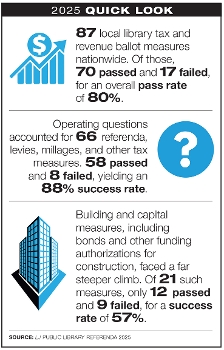
Taken together, the 2025 election results show that voters are willing to reauthorize funding for core library services, but they are far more hesitant to authorize new funding for operations or facilities. In 2025, EveryLibrary and Library Journal tracked 87 local library tax and revenue ballot measures nationwide. Of those, 70 passed and 17 failed, for an overall pass rate of 80 percent. While that figure suggests continued voter goodwill toward libraries as civic institutions, a closer look reveals meaningful differences based on what libraries were asking voters to approve.
Operating referenda are ballot measures to fund ongoing services or renew existing revenue. In 2025, operating questions accounted for 66 referenda, levies, millages, and other tax measures. Fifty-eight passed and eight failed, yielding an 88 percent success rate. By contrast, building and capital measures, including bonds and other funding authorizations for construction, faced a far steeper climb. Of 21 such measures, only 12 passed and nine failed, for a success rate of 57 percent.
Within the operating referenda, there is a distinction between renewals of existing levies and millages and proposals for new money; it is one of the defining features of the 2025 election cycle. Last year, voters repeatedly demonstrated their willingness to preserve existing library services, even when those services depend on dedicated local taxes. Renewal measures passed by comfortable margins, often earning roughly two-thirds of the vote.
|
STATE BY STATE IN 2025 |
||||
| STATE | TYPE | FAIL | PASS | |
| CALIFORNIA | Local - Building | 0 | 1 | |
| CALIFORNIA | Local - Operations | 0 | 2 | |
| COLORADO | Local - Building | 1 | 0 | |
| IDAHO | Local - Operations | 1 | 0 | |
| ILLINOIS | Local - Building | 1 | 0 | |
| ILLINOIS | Local - Operations | 1 | 1 | |
| IOWA | Local - Building | 2 | 1 | |
| KANSAS | Local - Building | 1 | 0 | |
| LOUISIANA | Local - Operations | 2 | 8 | |
| MICHIGAN | Local - Building | 1 | 2 | |
| MICHIGAN | Local - Operations | 0 | 4 | |
| MISSOURI | Local - Operations | 1 | 1 | |
| NEW YORK | Local - Building | 0 | 1 | |
| NEW YORK | Local - Operations | 0 | 2 | |
| OHIO | Local - Building | 0 | 2 | |
| OHIO | Local - Operations | 2 | 29 | |
| OKLAHOMA | Local - Building | 0 | 1 | |
| OREGON | Local - Building | 1 | 0 | |
| OREGON | Local - Operations | 0 | 2 | |
| PENNSYLVANIA | Local - Operations | 1 | 0 | |
| TEXAS | Local - Building | 2 | 3 | |
| VIRGINIA | Local - Building | 0 | 1 | |
| WASHINGTON | Local - Operations | 0 | 7 | |
|
SOURCE: LJ PUBLIC LIBRARY REFERENDA 2025 |
||||
LOCAL STORIES
 In several communities, the 2025 election results meant new opportunities. In Virginia, voters delivered a decisive yes for the Loudoun County Public Library, approving a multi-departmental bond with roughly 74 percent support in a high-turnout election. The measure funds expanded and modernized parks, recreation, library, and public safety facilities in one of the fastest-growing counties in the country, where library use has consistently outpaced available space. On the opposite coast, voters in Oregon backed continued access in urban, suburban, and rural settings by approving an operating levy for Washington County Cooperative Library Services and one for the Salem Public Library. A similar story played out in neighboring Washington state, where voters handily approved Prop 1 for the Kitsap Regional Library, Prop 2 for the Whatcom County Library System, and Prop 1 for the Upper Skagit Library.
In Louisiana, voters narrowly approved an operating renewal for the Iberia Parish Library. In a parish facing ongoing fiscal pressure, the renewal protects branch operations, staffing, and basic access to information services. Had the measure failed, the impact would have been immediate and deeply felt. The same was true in Michigan, where the Muskegon Area District Library secured an increase of its operating funding with just over 50 percent of the vote. The measure’s passage preserves access for multiple municipalities served by the district and prevents immediate service cuts.
Unfortunately, not every close contest ended in a win. In Louisiana, voters rejected an operating funding measure for the East Baton Rouge Parish Library, with only 47 percent voting in favor. The loss came in a high-turnout election and leaves one of the state’s largest parish library systems without the additional stability the measure would have provided. Ste. Genevieve County Library in Missouri failed to pass Prop L to increase the millage from $.045 to $.15. The Bee Cave Public Library in Texas had a split decision on two building-related questions. The future of the project is unclear.
Unlike recent years, we did not track on any ballot measures to defund or close a library. In fact, in Huntington Beach, CA, citizens placed two measures on the ballot by petition to safeguard the library. One measure was to repeal a city council ordinance that established a parental content review board. The other measure was to change
the city charter to prevent privatization of the library in the future. The campaign by the Our Libraries Matter / Save HB Library committees were a master class in community organizing and voter engagement. Both positive measures passed.
|
PASSAGE RATE TRENDING |
||||||
| OPERATING REFERENDA | BUILDING REFERENDA | |||||
| PERCENTAGE | PERCENTAGE | |||||
| YEAR | NUMBER | PASS | FAIL | NUMBER | PASS | FAIL |
| 2025 | 66 | 87% | 13% | 21 | 58% | 42% |
| 2024 | 115 | 90% | 10% | 16 | 62% | 38% |
| 2023 | 109 | 95% | 5% | 25 | 68% | 32% |
| 2022 | 134 | 87% | 13% | 32 | 56% | 44% |
| 2021 | 64 | 94% | 6% | 22 | 77% | 23% |
| 2020 | 146 | 90% | 10% | 20 | 85% | 15% |
| 2019 | 124 | 93% | 7% | 24 | 71% | 29% |
| 2018 | 109 | 88% | 12% | 41 | 61% | 39% |
| 2017 | 85 | 98% | 2% | 39 | 72% | 28% |
| 2016 | 121 | 86% | 14% | 47 | 68% | 32% |
| 10 YEAR AVERAGE: |
113 | 92% | 9% | 29 | 66% | 34% |
| 2015 | 123 | 94% | 6% | 21 | 43% | 57% |
| 2014 | 147 | 81% | 19% | 33 | 73% | 27% |
|
SOURCE: LJ PUBLIC LIBRARY REFERENDA 2025 |
||||||
RENEWAL AND NEW MONEY ELECTIONS
 Nationally, over the previous 10 years, voters tend to approve library funding to preserve what they already know but are far more cautious when asked to invest in what libraries might become. This year in Ohio, for example, all but two of the 31 levy questions passed, but most were for renewals. This suggest that libraries are a part of their communities’ sense of public infrastructure, and in that sense, operating renewals benefit from voter familiarity.
But when ballot measures moved beyond preservation and into expansion, whether through increased operating revenue or capital investment, voter behavior was significantly different. Measures that sought new or expanded funding passed at significantly lower rates and with noticeably slimmer margins. While some succeeded, many did so narrowly. Others failed outright, often despite active local support and well-documented facility needs.
If renewal election days are about protection of an existing public good, new-money elections need to be persuasive that the service merits expansion.
Building and capital measures highlight a longstanding challenge for libraries. While voters generally support the idea of libraries, they are far more cautious when asked to fund bricks-and-mortar projects. This hesitation persists despite the aging condition of many library facilities, which often struggle with deferred maintenance, accessibility limitations, and outdated infrastructure.
We did not track any ballot questions about governance in 2025, nor did we see any defunding or discontinuance questions like we have in the recent past. Geographically, the 2025 ballot landscape was uneven. Ohio (with 31 elections), Louisiana (with 10), and Washington state (with seven) accounted for a disproportionate share of measures. Voter participation levels varied widely across the 2025 elections. Total votes cast on individual library measures ranged from fewer than 200 ballots to more than 160,000 votes in large countywide contests. High participation did not guarantee easy victories, nor did low turnout automatically doom a measure.
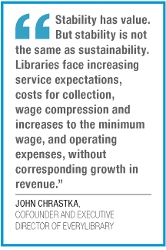
Stability has value. But stability is not the same as sustainability. Libraries face increasing service expectations, costs for collection, wage compression and increases to the minimum wage, and operating expenses, without corresponding growth in revenue. A pattern of perpetual renewal risks locking libraries into a defensive posture and erodes the buying power of mill levy and parcel tax funding alike. Stability at the ballot box cannot be mistaken for sustainability.
John Chrastka is the cofounder and Executive Director of EveryLibrary, the national political action committee for libraries.

Added To Cart
RELATED

RECOMMENDED

TECHNOLOGY
ALREADY A SUBSCRIBER? LOG IN
We are currently offering this content for free. Sign up now to activate your personal profile, where you can save articles for future viewing
ALREADY A SUBSCRIBER? LOG IN
Thank you for visiting.
We’ve noticed you are using a private browser. To continue, please log in or create an account.
Add Comment :-
Comment Policy:
Comment should not be empty !!!