


2018 School Spending Survey Report
Necessary Trouble: Washington University in St. Louis Film and Media Archives | Archives Deep Dive
The mission of the Washington University in St. Louis Film & Media Archive is to preserve documentary film and media about the United States’ political and social movements, focusing on the Civil Rights movement and African American history.
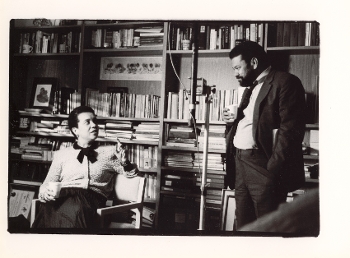 |
Henry Hampton and Marian Wright Edelman during the filming of her interview for Eyes on the Prize II.Photo courtesy of the Henry Hampton Collection, Washington University Libraries. |
The mission of the Washington University (WashU) in St. Louis Film & Media Archive (FMA) is to preserve documentary film and media about the United States’ political and social movements, focusing on the Civil Rights movement and African American history.
The archive began with the acquisition of the Henry Hampton Collection in 2002. St. Louis–born Henry Hampton (1940–98) founded the film production company Blackside, Inc., in Boston. At the time, it was considered the largest African American–owned film company. Hampton is best known for the two-part documentary series Eyes on the Prize (1987 and 1990) which aired on PBS and is still considered the quintessential film about the civil rights movement.
When Hampton died in 1998, Bob Hohler, board member of the Civil Rights Project, Inc. (CRPI)—the nonprofit wing of Blackside—wanted to make sure the collection found a permanent home, ideally at an institution of higher education.
WashU presented a proposal to house the archives, which included hiring an archivist for the collection and creating a space for it. Nadia Ghasedi, associate university librarian for special collections, said that the CRPI “selected us because they knew that this would be the crown jewel [at WashU], not just another collection.” Housing the collection at WashU also made sense since Hampton was an alumnus. Ghasedi first worked on the archives as a student in summer 2003 and returned as a cataloging and preservation archivist in 2007 (she became an associate university librarian for special collections services in 2016).
BUILDING THE COLLECTION
Since the collection was first acquired, word of mouth has played a big role in gathering more material for the archive, Ghasedi said. “Because of the notoriety of Henry Hampton and Blackside, many people came to us [about donating their archives], so we didn’t have to really go out and search.”
In 2005, the archives received the William Miles Collection. Miles was a documentary filmmaker who focused on African American excellence in arts, sports, and military in films like Men of Bronze (1977), about African American soldiers fighting with French soldiers in WWI, and James Baldwin: The Price of the Ticket (1989), which was an episode of PBS’s American Masters series.
In addition to the Hampton and Miles collections, the archives also holds educational films, largely from the St. Louis Public School system; burlesque films from the 1930s to 1960s produced in and around St. Louis; and interviews from the PBS seven-part series The Great Depression in 1993.
In 2020, FMA acquired the records of Kartemquin Films, a Chicago-based documentary company. Unlike its other collections, WashU did pursue them.
In 2011, Ghasedi attended the True/False Film Fest in Columbia, MO, which celebrates international nonfiction film. There, she heard director Steve James presenting his film, The Interrupters. After his talk, Ghasedi emailed Kartemquin, inquiring about their plans to conserve and preserve their materials. The company had no official plans, but was interested in housing them with WashU. Nothing came of the discussion until a few years later, when Carolyn Faber, a consultant archivist for the film company, asked Ghasedi if WashU was still interested. With the acquisition, the FMA hired Project Film Preservationist and Interim Curator for Film and Media Lydia Creech to process the collection in 2023.
The FMA has grown from the estimated 35,000 items in the Henry Hampton Collection to include 6,500,000 feet of film, about 20,000 videotapes, more than 10,000 audiotapes and reels, and 1,300 linear feet of manuscripts.
The archives are still expanding. Ghasedi noted that the FMA recently acquired the photography of Meg Gerken, the late wife of Gordon Quinn, one of the founders of Kartemquin. Because Gerken’s archive includes materials related to work outside of Kartemquin, WashU will designate it as a separate collection.
A TREASURE TROVE OF MATERIALS
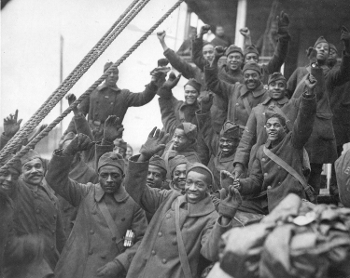 |
“Harlem Hellfighters” of 369th RegimentPhoto courtesy of the William Miles Collection, Washington University Libraries. |
Since its founding 2002, FMA has become a powerhouse of documentary materials about the history of the United States, particularly the Civil Rights Movement and other 20th-century events and experiences.
The archive is more than a film library. Since Hampton and the collection’s other filmmakers had the wherewithal to keep many of the materials related to making their films—raw footage, ephemera, and outtakes—researchers can see the choices that they made in the filmmaking process, explained Ghasedi.
The Hampton Collection is extremely thorough. “It’s the gold standard of documentary filmmaking,” Ghasedi said. “For every line of narration, [their fact checkers] have it highlighted, and then behind it they’d have scholarly sources to back up whatever the narrator said.” Stock footage had to be real. For example, when the producers of Eyes on the Prize were looking at footage of marching feet, Hampton told the team that if those feet weren’t marching at the specific event being featured, they couldn’t use it in the documentary. There was no filler material. “They really did incredible research, and there’s a lot of insights into the filmmaking process” in the collection, Ghasedi said.
The Eyes on the Prize collection contains interviews with more than 200 people. Ghasedi estimated that there were 180 hours of complete interviews, only a small portion of which were used in the documentary. These archives include digitized interviews with civil rights luminaries such as Coretta Scott King, Rosa Parks, and Huey P. Newton, one of the cofounders of the Black Panther Party.
FMA’s holdings are so extensive that occasionally original creators of footage have reached out to WashU when they cannot find the work in their own collections.
Richard Beymer, best known as Tony in the film West Side Story, was one of the Freedom Summer volunteers from the Student Nonviolent Coordinating Committee (SNCC), and created the documentary film A Regular Bouquet: A Feeling of Mississippi Summer Project, which chronicles the lives of people registering Mississippi voters in 1964.
The film was used in subsequent documentaries, including Eyes on the Prize , but Beymer himself did not have a copy. When he called Ghasedi to ask if FMA had a copy, he also wondered if they would be interested in additional materials, including photographs and 16mm reversal stock. Beymer ended up donating those materials and even came to campus to talk about the Freedom Summer and his documentary. Thanks to a National Film Preservation Foundation grant, FMA was able to digitize and make it available online.
Other treasures include the Jack Willis Collection, acquired in 2014. Jack Willis was a documentary filmmaker and producer who interviewed many of the movers and shakers of the Civil Rights movement from 1978 to 1982, working around the same time as Hampton. He had a prolific career producing documentaries for National Education Television (now PBS) and a variety of other films. He never completed his Civil Rights movement documentary, but his audio, video, and other materials have been included in the WashU collection. Many of those materials have been digitized.
In addition to substantial material related to civil rights and other movements in the United States, the archives contain items from WashU’s own history, including what is considered the first student film ever made: The Maid of McMillan, from 1916. The 15-minute fictional film written by WashU students Dan Bartlett and Donald Stewart was made for an early incarnation of Wash U’s annual Thurtene Carnival, a student-run event held on campus. In 2022, the archive received a National Film Preservation Foundation grant to restore and digitize the film.
SCHOLARS, STUDENTS, LITIGANTS
Scholars have found the archive useful. Recently, American University Professor Patricia Aufderheide published Kartemquin Films: Documentaries on the Frontlines of Democracy in 2024. In 2017, Jon Else, series producer and cinematographer for Eyes on the Prize and professor emeritus at University of California Berkeley Journalism Department published True South: Henry Hampton and ‘Eyes on the Prize.’
The archives provided significant material for the 2025 HBO original documentary series Eyes on the Prize III: We Who Believe in Freedom Cannot Rest.
Originally, WashU history classes were the primary users of the collection. In recent years, more media studies instructors have been incorporating the archives into the curriculum, such as John Powers, assistant professor, film and media studies, who used the collection extensively in his graduate level class “Film Historiography.” Former WashU Curator of Films and Media Andy Uhrich used the collections to teach “Media Archives: Political and Technological Interventions.”
In addition to classes and research, some of the archival materials have found their way into recent court cases. In 1965 John Fleming, a journalist from the Anniston Star in Alabama, was investigating the cold case murder of Jimmy Lee Jackson, a deacon and activist. Jackson’s death is credited as the catalyst for the Selma to Montgomery marchers who were attacked in what is now known as Bloody Sunday.
After receiving the FBI file in the 2000s, Fleming began looking into the case. The file was highly redacted, but when he talked to Judy Richardson, one of the producers of Eyes on the Prize, he learned that the WashU FMA had an older version of the FBI file that was not as heavily censored.
Ultimately, Fleming’s research resulted in the indictment of the state trooper who shot Jackson, Ghasedi noted. However, the archive also contains an unused interview with Dr. William Dinkins, a Black physician who blamed Jackson’s death—he was shot in the stomach and died on the hospital operating table—on the operating physician.
The defense wanted to use the interview to shift blame for Jackson’s death to the operating doctor. However, Ghasedi pointed out that the interview was not used in the original documentary because Hampton could not corroborate Dinkins’s testimony. “We ended up supplying stuff for both the prosecution and defense. But in the end, if an archive hadn’t kept that FBI file, I don’t think the journalist would have had the leads [to pursue justice for Jackson],” she said.
The FMA has also actively brought films into the larger St. Louis community. It first hosted “RawStock,” which showcased several of the educational films in the collection, in 2014. In subsequent years, the archives partnered with the St. Louis International Film Festival, and WashU brought some educational films to screen at a local movie house. “These films were intended for classroom use,” Creech said, “We’re taking them out to [the] community and showcasing the fun and weird stuff we have.”
While FMA safeguards and shares older films, it is also looking to the future of film preservation. With ongoing changes in technology, archivists are constantly thinking about new ways and technologies to conserve media. “Film collections of the future will not look like collections of the past,” Ghasedi said. Right now, film is stored digitally and can be reproduced without any seeming loss in quality. “But there’s nuance there,” she pointed out, “We don’t want to lose a whole generation of filmmaking because it was shot on a variety of digital media.”
For now, many materials are now available online on the WashU Film and Media Archives websites. If people are interested in visiting the archives in person, they can make an appointment and/or contact Lydia Creech at clydia [at] wustl.edu for more information.

Added To Cart
RELATED


RECOMMENDED
TECHNOLOGY
ALREADY A SUBSCRIBER? LOG IN
We are currently offering this content for free. Sign up now to activate your personal profile, where you can save articles for future viewing
ALREADY A SUBSCRIBER? LOG IN
Thank you for visiting.
We’ve noticed you are using a private browser. To continue, please log in or create an account.
Add Comment :-
Comment Policy:
Comment should not be empty !!!